
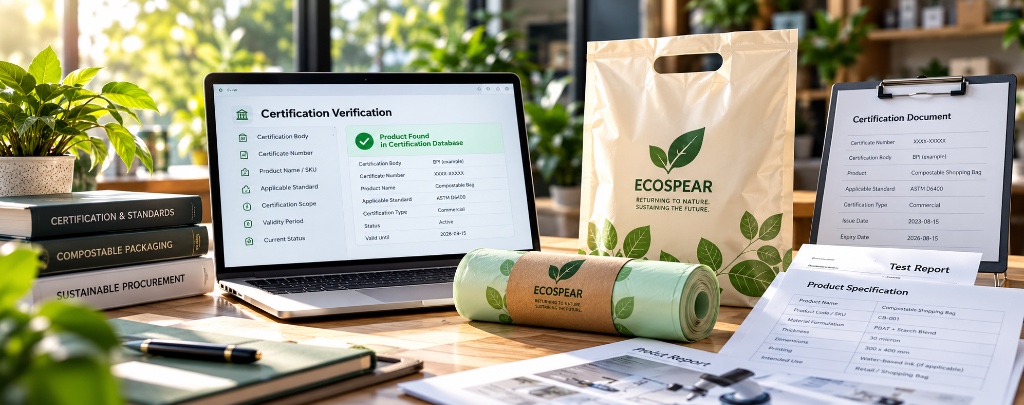
A Quick Answer
Don't verify a certificate by looking at the logo alone. Verify the certification body, certificate or license information, exact product, manufacturer, applicable standard, certification scope, specification limits and current status. Where a public certification database exists, use it to cross-check the supplier's claim.
1. Start With the Certification Body
First, identify who issued the certification. Reputable compostability certifications are provided by recognized third-party certification bodies, such as BPI, TÜV AUSTRIA, DIN CERTCO or other accredited schemes. A test report from a laboratory is not automatically the same thing as a product certification.
BPI
Biodegradable Products Institute
TÜV AUSTRIA
OK compost certification
DIN CERTCO
Certification for compostable products
Other Bodies
Accredited ISO/IEC 17065 conformity bodies
2. Identify the Exact Product
Check that the certificate clearly matches the exact product you are buying. Look for details such as:
Why is this critical? Because stating “our company uses certified raw material” does not automatically mean the finished converted bag, pouch, or packaging is certified. Certification bodies evaluate the finished product geometry, seal integrity, inks, and maximum wall thickness.
3. Check the Applicable Standard
Find out which standard the certificate is based on. Common standards include EN 13432, ASTM D6400, ASTM D6868 or NF T 51-800. Each standard has different scope and requirements. Learn more in our detailed guides:
European harmonized standard for packaging recoverable through composting.
Read articleU.S. standard specification for plastics designed for aerobic composting.
Read articleCompare regional differences, testing scopes, and market applicability.
Read article4. Check the Certification Scope
A certificate may apply to commercial/industrial composting, home composting, or both. It may also be limited to a specific product, formulation, thickness or configuration. Do not assume the certification covers everything a supplier sells.
| Scope Type | What to Check | Example |
|---|---|---|
| Composting environment | Commercial, Home or both | Commercial only or Commercial & Home |
| Product coverage | Specific product or product family | e.g. bags, films, food packaging |
| Formulation | Specific material formulation | e.g. PBAT + starch (as stated) |
| Specification limits | Maximum thickness/grammage | e.g. up to 50 micron |
| Product configuration | Size, type, printing, additives | e.g. printed or non-printed |
5. Check the Product Specification
Make sure the certified specification matches the exact product you are sourcing through this 6-step technical validation flow:
6. Check Whether the Certificate Is Current
Always verify the certificate's validity and current operational status across these five checkpoints:
(validity period)
number
(active / suspended)
(if applicable)
7. Cross-Check the Certification Database
Where a public database exists (e.g. BPI or TÜV AUSTRIA), search for the product using the company name, product name or SKU. Confirm that the details match the certificate and the product you are buying.
Search the BPI Certified Product Catalog
Access over 50,000 verified compostable items at products.bpiworld.org
8. Certificate ≠ Standard ≠ Test Report
These documents are related but not the same. Each serves a different purpose in the verification trail:
| Document Type | What It Tells You |
|---|---|
| Standard | Technical requirements and test methods |
| Test report | Results from specific testing (e.g. disintegration, biodegradation) |
| Certificate | Independent confirmation that a product meets the requirements of a certification scheme |
| Product database listing | Verification that a specific product is certified |
| Supplier declaration | Manufacturer's own statement (not a third-party certification) |
9. Common Red Flags
Be cautious if you encounter the following warning signs during supplier evaluations:
10. A 10-Point Buyer Checklist
Before approving a compostable packaging supplier, confirm:
11. Common Misunderstandings
Clarifying common questions about compostable certificates:
12. Frequently Asked Questions
Common questions about verifying compostability certificates:
?
What is a compostable packaging certificate?
A compostable packaging certificate is a formal conformity document issued by an accredited third-party certification body confirming that a specific product meets the technical requirements of an established standard (e.g. EN 13432 or ASTM D6400).
?
How do I verify home compostability?
Confirm that the certificate explicitly designates "Home Compostable" (such as TÜV AUSTRIA OK compost HOME or BPI Commercial & Home). Commercial/industrial certificates do not validate home compostability.
?
How can I verify a BPI certificate?
Search BPI's public catalog at products.bpiworld.org by company name, product title, or SKU, and verify that the active license details match the product supplied.
?
What information should appear on a certificate?
It must include the certification body, unique certificate number, manufacturer name, exact product model/SKU, governing standard, maximum certified thickness, issue date, and expiry date.
?
How do I verify EN 13432 certification?
Check the certifier (e.g. TÜV AUSTRIA or DIN CERTCO), confirm the certificate references EN 13432, and check the certifier's database using the registration number.
?
Can a certified material be used in an uncertified product?
Yes, but the finished product is not certified until it is independently evaluated for final thickness, geometry, and inks.
?
Is a test report the same as certification?
No. A test report provides laboratory test data for a single sample. Certification is an overarching conformity program that licenses the product and verifies ongoing compliance.
?
How do I know if a certificate is still valid?
Check the expiration date on the certificate and verify on the issuing body's online directory that the certificate is currently active and not suspended.
?
Does certification apply to every product from a manufacturer?
No. Certification is issued on an individual product, SKU, and formulation basis. Each product format must be separately verified.
?
What should I ask a compostable packaging supplier?
Ask for the certificate number, issuing body, exact product name, certified thickness, and a direct link to the certifier's public catalog record.
The Bottom Line
Don't buy the certificate. Verify the product. A credible compostability claim connects four things: Product → Specification → Standard → Independent Evidence. If those links are clear and independently verifiable, the claim becomes reliable and procurement confidence is achieved.
Related Articles
EN 13432 Explained: What the Compostable Standard Means
10 min read
ASTM D6400 Explained: What It Means for Compostable Packaging
10 min read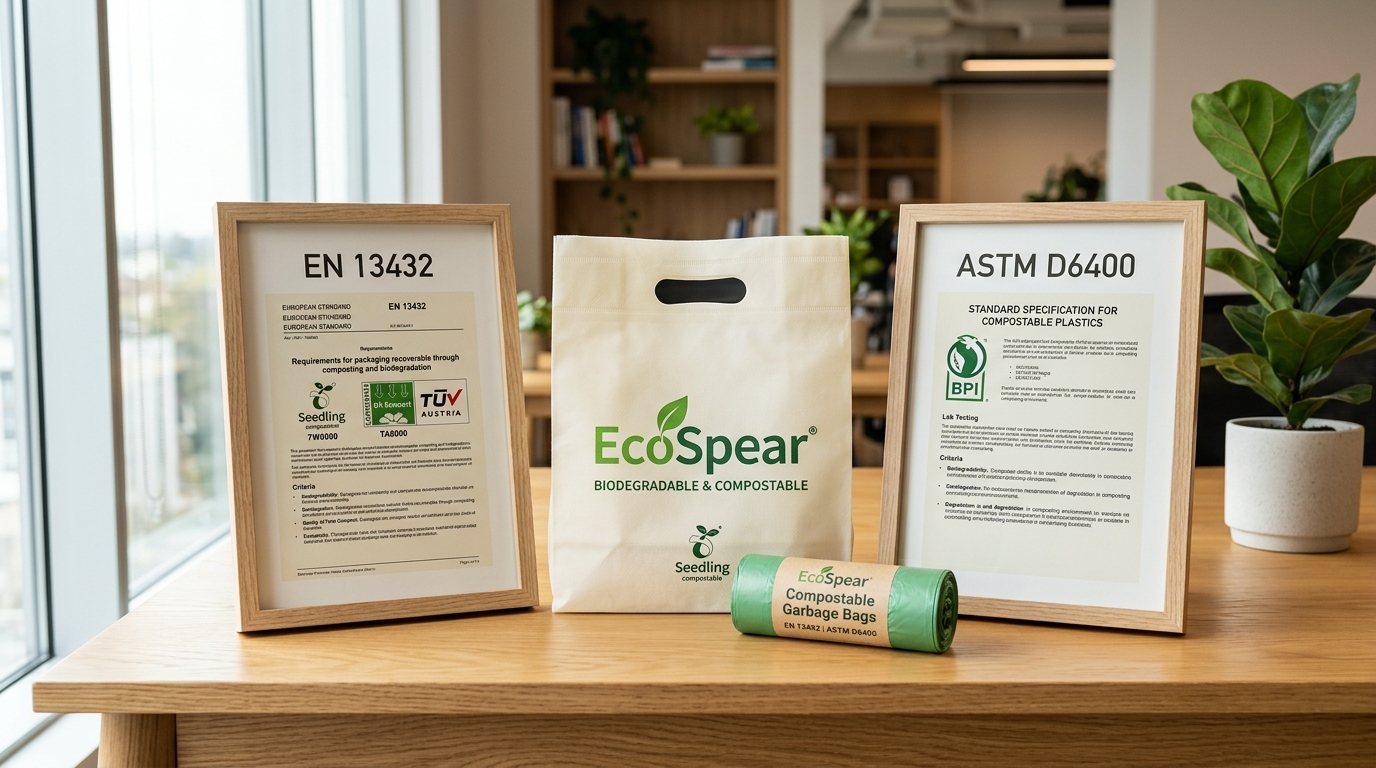
EN 13432 vs ASTM D6400: Understanding the Differences
12 min read
Home Compostable vs Industrial Compostable
10 min read
BPI Certification Explained: What Buyers Should Know
11 min readNeed compostable packaging for a real-world application?
Procurement teams can review technical packaging specifications across our D-Cut Bags and Garment Poly Bags, or contact our engineering team.