
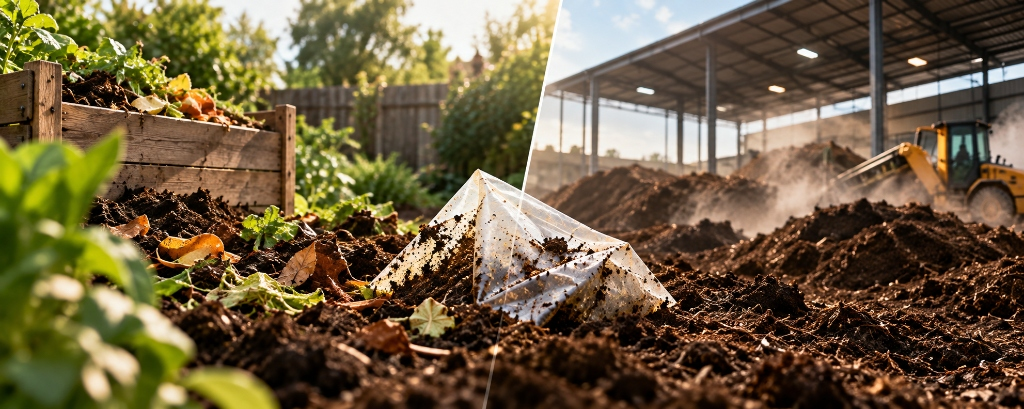
A Quick Answer
When packaging is described as compostable, one important question is often overlooked: Where is it supposed to compost?
A product designed for a commercial or industrial composting facility is not automatically suitable for a home compost pile. Both pathways involve biological breakdown, but the physical and biological environments can be very different.
The Essential Distinction
Industrial compostability is designed and evaluated for defined conditions in managed composting facilities. Home compostability is designed and evaluated for properly managed household composting conditions.
A product certified for industrial or commercial composting should therefore not automatically be described as home compostable.
Certification systems recognize this distinction. For example, BPI currently offers separate Commercial Compostability Certification and Home Compostability Certification programs. BPI states that its home certification is built on top of its commercial certification program but uses different requirements reflecting the different biological environments.
What Is Industrial or Commercial Composting?
Industrial or commercial composting takes place in a managed facility rather than an individual household compost pile.
The facility can control or manage critical operational factors:
The exact operating conditions vary by facility and composting system. For packaging standards, however, the important point is that testing is performed under defined and controlled conditions. For example, ASTM D6400 is a standard for plastics and plastic products designed for aerobic composting in municipal or industrial facilities.
What Is Home Composting?
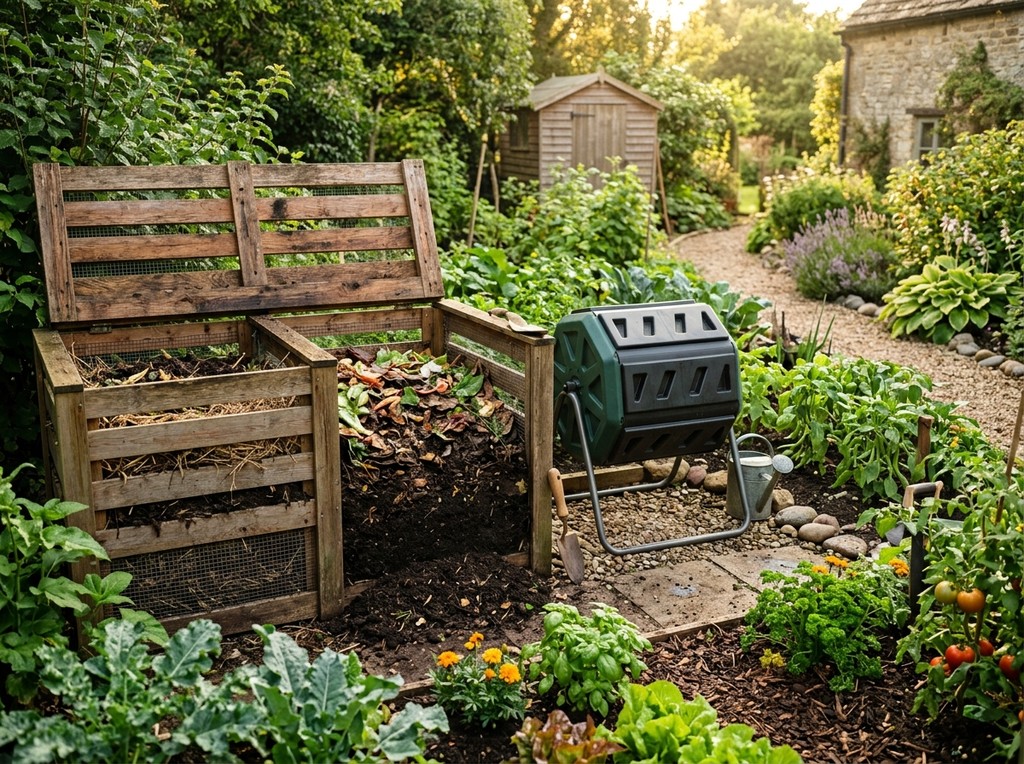
Home composting takes place at household scale. A home compost bin or pile is affected by local climate, outdoor temperature, moisture, aeration, pile size, composting method, frequency of turning, and the balance of organic materials.
Unlike a professionally managed composting facility, a household compost system can vary substantially from one location to another. That variability is one reason home compostability requires its own specialized technical evaluation.
The Key Difference: The Composting Environment
Two environments. Different biological conditions. Different outcomes:
Two Environments. Different Conditions.
 20°C–30°C
Home Composting
Household scale, variable conditions 55°C–60°C
Industrial Composting
Managed facility, controlled aeration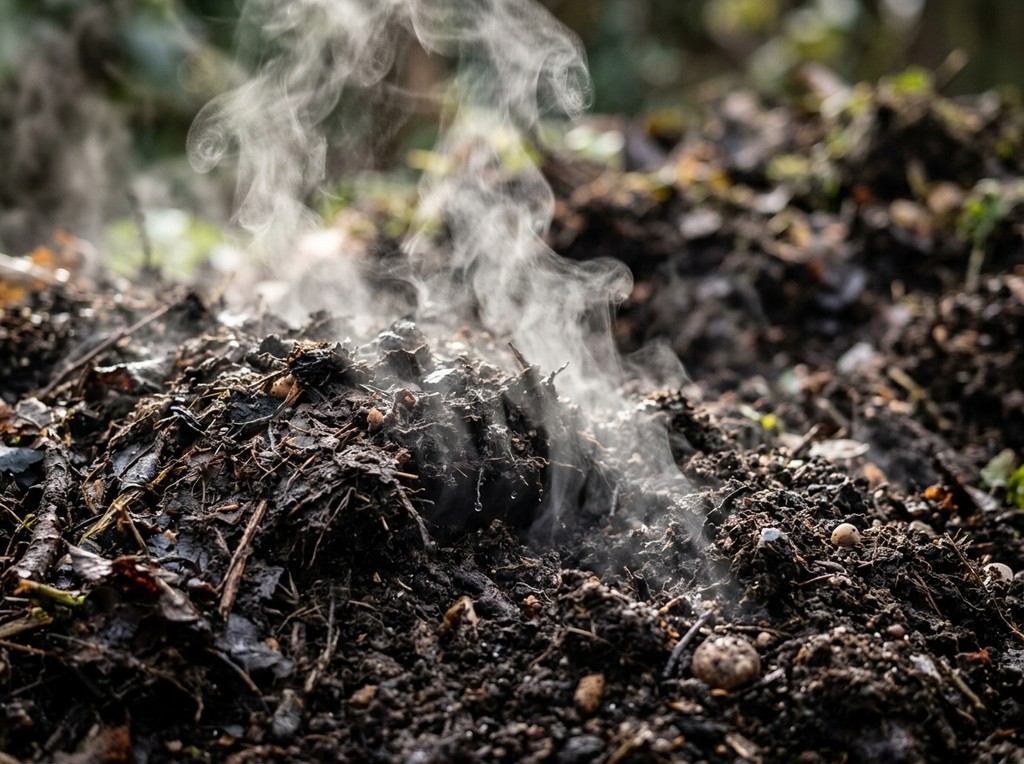 Thermal Heat
Temperature
Higher vs lower temperatures Timeframe
Processing Time
Different timeframes & system designs| Aspect | Industrial / Commercial Composting | Home Composting |
|---|---|---|
| Scale | Managed facility | Household |
| Environment | Controlled or managed | Variable |
| Temperature | Defined testing conditions (55°C–60°C) | Lower and more variable (20°C–30°C) |
| Moisture | Managed | Depends on conditions |
| Oxygen | Managed through facility processes | Depends on composting method |
| Processing | Managed composting system | Household composting |
| Certification | Specific commercial/industrial certification | Separate home-compostability certification |
| Suitable for home? | Not automatically | Yes, when appropriately certified/supported |
The takeaway: The phrase “compostable” alone does not answer the entire end-of-life question. Always verify the specific conditions and certification scope.
Why Temperature Matters
Temperature is one of the clearest differences between managed commercial composting and home composting. Commercial composting systems reach and sustain thermophilic conditions (55°C–60°C) that accelerate enzymatic and microbial breakdown. Household compost heaps fluctuate with outdoor weather and rarely sustain elevated temperatures.
Because biological breakdown is governed by temperature, laboratory test protocols must reflect the target environment:
58 ± 2°C (Up to 84 Days)
Disintegration testing under sustained high thermophilic heat and controlled aeration.
25 ± 2°C (Up to 180 Days)
Disintegration testing at ambient room temperature reflecting household realities.
These test durations demonstrate an essential fact: home and commercial compostability are evaluated under completely different parameters because the environments are biologically distinct.
Home compostable does not mean “composts anywhere.”
A home-compostable certification does not mean a product will disappear anywhere in nature. It means the item has been verified against standards for a managed household compost system. Factors such as moisture, oxygen, microbial activity, and pile management still matter.
Industrially compostable does not automatically mean home compostable.
If a supplier legitimately states a product is certified for commercial composting, that does not establish backyard compostability. If your customers or municipal regulations require home composting, ask for explicit home-compostability certification.
What Does “Home Compostable” Certification Actually Evaluate?
Home compostability is not simply a claim that a material biodegrades at ambient temperature. Standard NF T 51-800 evaluates five mandatory criteria on the finished product:
Conversion of organic carbon into CO₂, water, and biomass at ambient temperatures.
Physical fragmentation into pieces under 2mm within the designated timeframe.
Plant growth trials ensuring the resulting compost supports healthy soil biology.
Strict limits on heavy metals, fluorine, and hazardous chemical additives.
Finished Product Rule: Packaging is rarely one single polymer. Inks, coatings, adhesives, and masterbatch additives must all be verified. Individual component compliance is required for complete packaging certification.
Home vs Industrial: Certification at a Glance
| Certification Question | Industrial / Commercial | Home Composting |
|---|---|---|
| Is commercial composting covered? | Yes, where certified | Yes, for schemes requiring commercial prerequisite |
| Is home composting covered? | Not automatically | Yes, when specifically certified |
| Are testing conditions different? | Yes (58°C high heat) | Yes (25°C ambient) |
| Does certificate apply to every SKU? | No (product-specific) | No (thickness & formulation specific) |
| Can generic “compostable” establish home? | No | No |
| Should buyers verify exact certificate? | Yes | Yes |
Certification and Standards Breakdown
Key international standards and certification bodies governing compostable packaging:

BPI Certification
North America’s leading compostable certifier offering Commercial and Home programs (launched 2025).
NF T 51-800
French national standard specifying test methods and thresholds for home-compostable plastics.
ASTM D6400-26
North American standard for plastics designed for aerobic composting in municipal or industrial facilities.

EN 13432
European harmonized standard for packaging recoverable through industrial composting.
What Should a B2B Buyer Ask a Supplier?
If your business specifically requires home-compostable packaging, ask your supplier these direct questions:
Is the product home compostable?
Do not accept “yes” based only on a generic compostable claim. Ask for supporting test evidence.
Which certification covers home compostability?
Ask for the specific accredited certification body (e.g. BPI, TÜV Austria, DIN CERTCO) and scheme.
What is the certificate number?
A traceable certificate number enables independent verification in public certifier databases.
Which exact product is covered?
Confirm product name, SKU, dimensions, and thickness match your procurement invoice.
Does it cover the finished product?
Do not assume raw resin certification automatically validates inks, adhesives, and finished bags.
What happens after formulation changes?
Verify that thickness alterations or custom print jobs maintain valid certified scope.
Claim Verification Pathway
Does Home Compostable Mean Better?
Not automatically. The objective is to select packaging whose material, performance, certification, and end-of-life pathway match the actual application and available infrastructure.
5-Step Procurement Decision Framework:
Common Misunderstandings
Clear, evidence-based clarifications for widespread assumptions:
Frequently Asked Questions
Direct answers to common questions about home and industrial compostability:
Is home compostable better than industrial compostable?
Neither is universally better. The right choice depends on your product’s use case, target consumer habits, destination market regulations, and local composting collection infrastructure.
Can an industrially compostable bag go into a home compost bin?
You should not assume so. Backyard compost piles rarely reach the sustained 58°C temperatures required to disintegrate industrial compostables. Always check whether the bag is specifically certified for home composting.
Can a home-compostable bag also be industrially compostable?
Yes, in many cases. For example, BPI's Home Compostability Certification is built on top of its Commercial Compostability Certification as a prerequisite.
What standard is used for home compostability?
One key benchmark is AFNOR NF T 51-800, a French standard covering plastics suitable for home composting. BPI's Home Compostability Program is based on NF T 51-800. In Australia, AS 5810 is widely referenced.
Does BPI certify home-compostable products?
Yes. BPI operates both Commercial Compostability Certification and Home Compostability Certification programs (home program launched in 2025).
The most important distinction is the environment behind the claim.
A serious packaging decision connects:
When those pieces align, “compostable” becomes a verifiable technical claim rather than an unproven marketing statement.
EXPLORE THE NEXT LAYER
Related Technical Guides & Research:
Specify the Right Compostable Packaging for Your Market
Custom certified home and industrial compostable bags tailored for retail, fashion, food service, and industrial supply chains.