Key Takeaways
Ecospear works with government institutions, scientific organisations, development partners and local stakeholders to support evidence-based policies and practical standards for compostable packaging in Bangladesh.
Why Policy and Standards Matter
Bangladesh's transition towards more responsible packaging requires clear standards, credible testing, informed regulation and practical implementation. Policy and standards help establish a common technical language, improve confidence in material claims, and provide businesses with a clearer path towards sustainable innovation.
Without robust national definitions and verified standards, genuine compostable materials often compete against non-degradable conventional plastics mislabeled as "eco-friendly" or oxo-degradable products that fragment into persistent microplastics. A strong standards framework protects honest manufacturers, builds export credibility for apparel and consumer sectors, and provides municipal waste operators with predictability.

Key questions policy and standards help address:
- How should compostability be verified under local and international standards?
- What distinction must be drawn between truly biodegradable polymers and conventional plastic?
- Which laboratory protocols guarantee safe degradation without chemical residues?
- How do packaging standards align with industrial composting and municipal waste infrastructure?
- What labelling rules ensure export compliance and consumer clarity?
- How can regulatory agencies protect the market from deceptive greenwashing?
Supporting the Development of Compostable Packaging Standards
Ecospear has contributed practical industry knowledge to discussions surrounding compostable packaging standards in Bangladesh. This includes sharing real-world manufacturing experience, technical insights and the importance of reliable testing and clear assessment criteria.
Formulating effective national technical standards requires bridging scientific research with factory-floor reality. Material processability, tensile strength, barrier integrity, and degradation kinetics in diverse environments must be accounted for so standards foster viable, scalable industrial adoption.
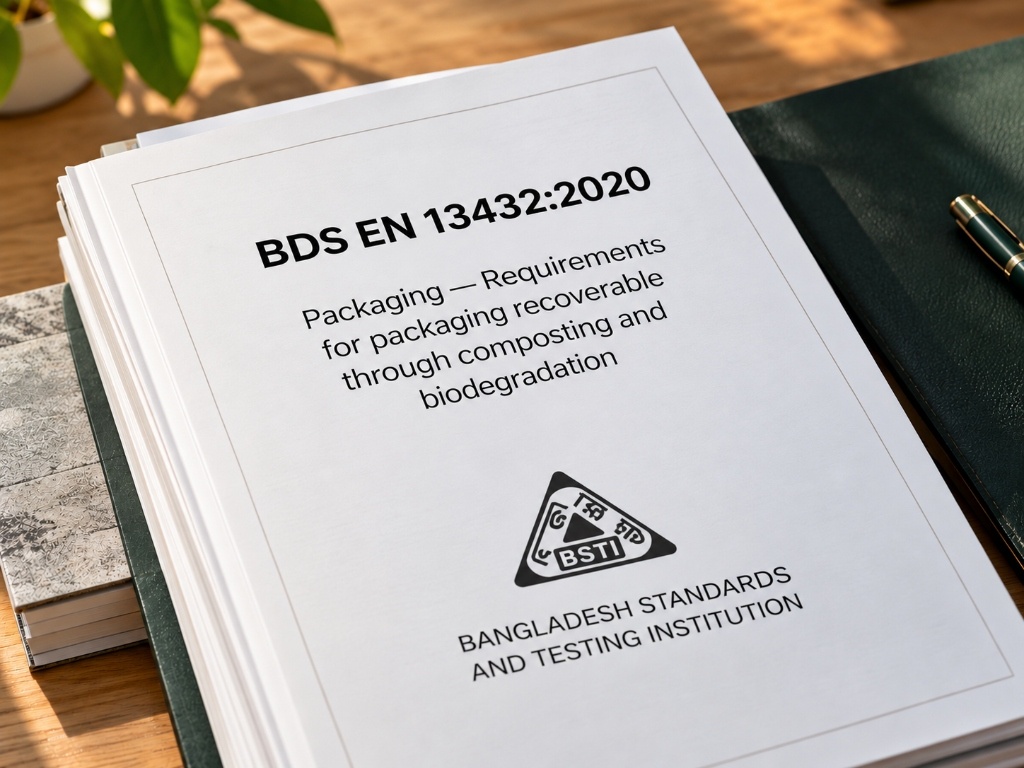
BDS EN 13432:2020
Bangladesh's national standard for packaging recoverable through composting and biodegradation. Adopted from harmonised international specifications, it establishes four mandatory evaluation pillars:
Biodegradability
Over 90% biodegradation achieved within 180 days under controlled aerobic composting conditions, converted cleanly into CO₂, water, and biomass.
Disintegration
Complete physical breakdown to less than 2mm particle size within 12 weeks of biological treatment, leaving no visible polymeric fragments.
Process Neutrality
Zero negative effects on the composting process, microbial community activity, carbon-nitrogen balance, or natural exothermic heating cycle.
Compost Quality
Rigorous ecotoxicity and agronomic plant germination assays ensuring zero heavy-metal toxicity or phytotoxic chemical residues in the resulting soil.
Working Across Institutions
Ecospear has supported government institutions, scientific stakeholders and other organisations with practical insights into compostable materials, recycling, waste management and the challenges of implementation. This experience helps connect industry realities with wider discussions on evidence-based policy and responsible packaging.

Department of Environment
Sharing field observations on single-use plastic reduction, waste-stream dynamics, and practical regulatory enforcement mechanisms to support national environmental policies.
BSTI
Contributing technical data and manufacturing parameters for the adoption and operationalization of national compostability specifications, including BDS EN 13432:2020.
BCSIR
Collaborating on laboratory testing protocols, bio-based resin characterization, and degradation analysis under local environmental conditions.
Engaging with Development Partners and Wider Stakeholders
Ecospear's work has extended across development-sector discussions, local authorities, city corporations, NGOs and other stakeholders. By sharing practical knowledge of materials, manufacturing and waste-management realities, Ecospear supports broader efforts to make sustainable packaging more technically informed and practical to implement.
Development Partners
Participating in technical dialogues with international development agencies and multilateral programs focusing on circular economy transitions, marine litter reduction, and green industrial financing.
Local Government & City Corporations
Sharing practical insight into municipal solid waste collection, organic waste separation, and composting facility integration across Dhaka, Chattogram, and regional municipalities.
NGOs & Civil Society
Engaging with environmental non-governmental organisations, research foundations, and consumer advocacy bodies to provide factual material science and curb misleading claims.
Industry & Supply Chain Partners
Working closely with apparel manufacturers, exporters (BGMEA/BKMEA members), retail chains, and polymer compounders to ensure supply-chain readiness and operational viability.
From Policy to a More Sustainable Future
Effective progress requires collaboration between policymakers, scientists, manufacturers, waste-management stakeholders and the wider business community. Ecospear will continue to contribute its practical experience to discussions that support credible packaging standards, responsible material choices and a more sustainable future for Bangladesh.
Policies and standards are living frameworks. As bio-based polymer technologies advance and national waste infrastructure modernises, continuous dialogue ensures regulatory standards remain agile, scientifically rigorous, and commercially feasible for exporters and local enterprises alike.

Frequently Asked Questions
Key questions on compostable standards, institutional roles and policy collaboration in Bangladesh.